
Villard Blanc - Grafted
All plant material purchased now will be
scheduled to ship in the Spring of 2025.
- Buy 50 for $5.25 each and save 62%
| Black Rot | Moderately susceptible |
|---|---|
| Downy Mildew | Moderately susceptible |
| Powdery Mildew | Highly susceptible |
| Botrytis | Slightly susceptible |
| Grape Color | White |
|---|---|
| Primary Use | Table, Wine |
| Wine Color | White |
| Variety Origin | Bertille Seyve-Villard |
| Parents | Seibel 6468 x Subereux |
| Pseudonym (Tested As) | SV 12-375 |
| Year Released | 1937 |
| Harvest Season | Late Season |
| USDA Hardiness Zone | 5, 6, 7, 8, 9, 10, 11, 12 |
| Black Rot | Moderately susceptible |
| Downy Mildew | Moderately susceptible |
| Powdery Mildew | Highly susceptible |
| Botrytis | Slightly susceptible |
| Sulfur Sensitivity | Slightly susceptible |
| Vine Vigor | Vigorous |
| Growth Habit | Upright |
| Suggested Distance Between Vines | 6 ft, 7 ft, 8 ft |
| Vine Training System | Mid Wire Cordon |
| Bud Break | Data Unavailable |
Mid Wire Cordon (MWC)
Mid-wire Cordon (MWC) training is used where neither Top Wire Cordon (TWC) nor Vertical Shoot Positioned (VSP) training is appropriate for the cultivator being grown. Examples include cultivators with upright shoot growth that do not require maximum sunlight exposure of the fruiting zone (i.e., cultivators that have relatively disease-resistant fruit that does not benefit from increased exposure to sunlight), and also cultivators with weak trunk growth due to inherent lack of vigor or susceptibility to winter injury. MWC training may be appropriate where training to TWC is difficult due to the difficulty in establishing permanent trunks, and where economics do not justify increased labor inputs associated with VSP training. MWC training employs a fruiting wire at 36-48”, with (generally) one set of catch wires at least 10” above the fruiting wire.
Download Mid Wire Cordon Training PDF
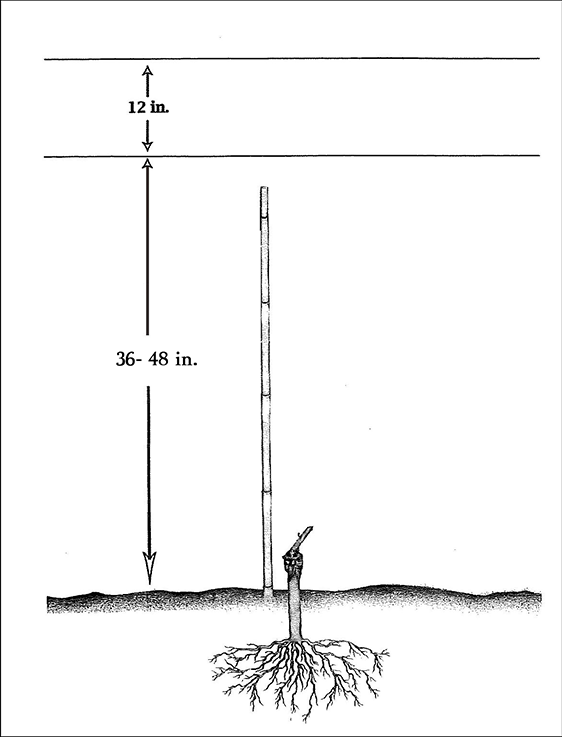 At planting, one or two buds are retained near the graft
union on grafted vines, or near the crown of the vine on
own-rooted vines. Support is provided with a bamboo stake or
other support. For grafted vines, the graft union should be
planted above the ground so the scion variety does not
produce roots. Where winter graft union protection is needed
in order to prevent winter injury, it is critical that the
graft union be planted close to the ground (1-2” above final
ground level), with graft unions covered with soil or other
insulating material during the winter months.
At planting, one or two buds are retained near the graft
union on grafted vines, or near the crown of the vine on
own-rooted vines. Support is provided with a bamboo stake or
other support. For grafted vines, the graft union should be
planted above the ground so the scion variety does not
produce roots. Where winter graft union protection is needed
in order to prevent winter injury, it is critical that the
graft union be planted close to the ground (1-2” above final
ground level), with graft unions covered with soil or other
insulating material during the winter months.
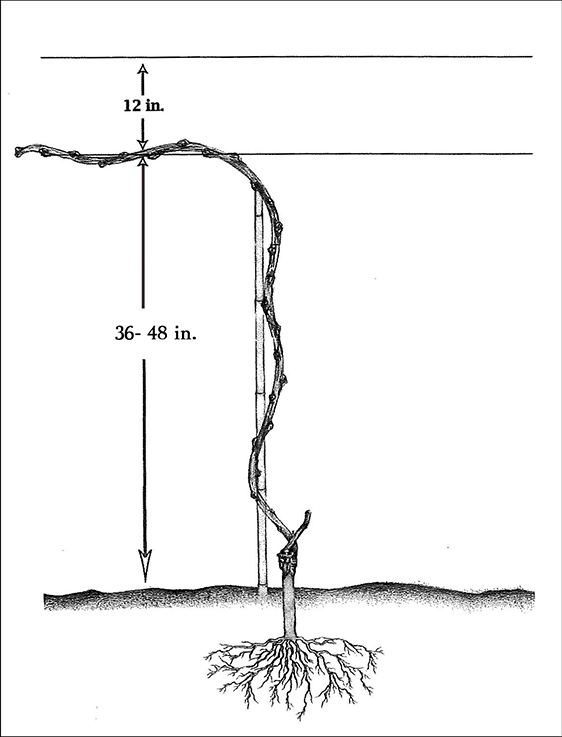 One cane is retained from the previous year’s growth. This
can be pruned and tied to the bottom wire, or a longer cane
can be trained up to or on top (fruiting) wire if first
years growth was vigorous. A second trunk can be started by
leaving a short spur at the base of the vine, just above the
graft union on grafted vines, or just above ground level on
own-rooted vines. In Year Two, crop should be limited by
cluster thinning or defruiting in order to encourage
vegetative growth.
One cane is retained from the previous year’s growth. This
can be pruned and tied to the bottom wire, or a longer cane
can be trained up to or on top (fruiting) wire if first
years growth was vigorous. A second trunk can be started by
leaving a short spur at the base of the vine, just above the
graft union on grafted vines, or just above ground level on
own-rooted vines. In Year Two, crop should be limited by
cluster thinning or defruiting in order to encourage
vegetative growth.
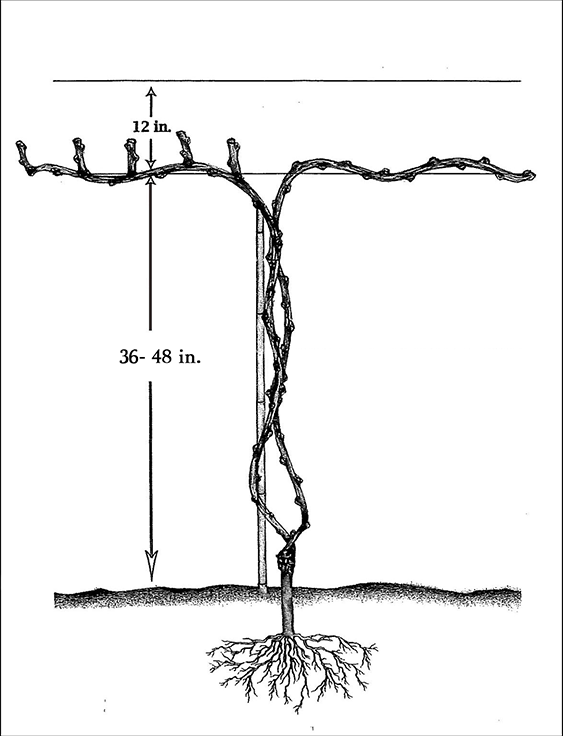 A single cane or cordon can be pruned and trained in each
direction from the head of the vine. Spurs on cordons should
be located about size inches apart. Highly fruitful
cultivators such as French-American hybrids can be pruned to
two to three bud spurs, while less fruitful cultivators can
be pruned to three to five bud spurs. Where possible, shots
emerging from cane growth below the fruiting wire should be
removed to avoid overcrowding and shading at the head of the
vine. During the growing season, shoots are allowed to grow
through the sets of catch wires, and additional shoot
positioning can be attained by manually tucking shoots
between the sets of catch wires, and additional shoot
positioning can be attained by manually tucking shoots
between the sets of catch wires. Shoots that emerge through
the top set of catch wires are allowed to grow downward,
generally without using any summer pruning. Third year vines
should yield between one-half and a full crop, depending on
the amount of trellis fill achieved. Vines that achieve full
trellis fill can be fully cropped (as appropriate for the
variety and desired wine quality attributes), while weaker
vines may require some fruit removal by cluster thinning so
that vines are not over-cropped.
A single cane or cordon can be pruned and trained in each
direction from the head of the vine. Spurs on cordons should
be located about size inches apart. Highly fruitful
cultivators such as French-American hybrids can be pruned to
two to three bud spurs, while less fruitful cultivators can
be pruned to three to five bud spurs. Where possible, shots
emerging from cane growth below the fruiting wire should be
removed to avoid overcrowding and shading at the head of the
vine. During the growing season, shoots are allowed to grow
through the sets of catch wires, and additional shoot
positioning can be attained by manually tucking shoots
between the sets of catch wires, and additional shoot
positioning can be attained by manually tucking shoots
between the sets of catch wires. Shoots that emerge through
the top set of catch wires are allowed to grow downward,
generally without using any summer pruning. Third year vines
should yield between one-half and a full crop, depending on
the amount of trellis fill achieved. Vines that achieve full
trellis fill can be fully cropped (as appropriate for the
variety and desired wine quality attributes), while weaker
vines may require some fruit removal by cluster thinning so
that vines are not over-cropped.
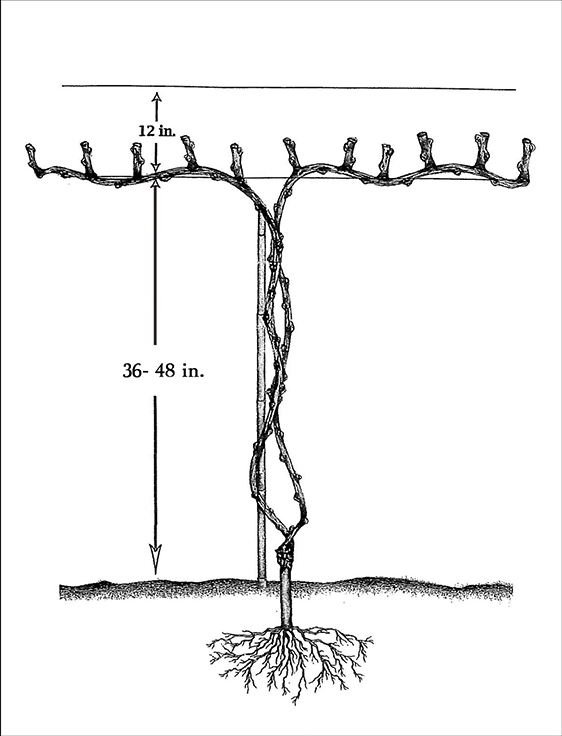 Cordons should be fully established and annual growth should
fill the available trellis space. Depending on the variety,
wine quality may be improved by reducing crop load, usually
by removing second and/or third clusters on developing
shoots. In regions where winter injury to trunks is
anticipated, new trunks can be trained by retaining one or
more suckers annually, and used to replace older,
winter-injured trunks.
Cordons should be fully established and annual growth should
fill the available trellis space. Depending on the variety,
wine quality may be improved by reducing crop load, usually
by removing second and/or third clusters on developing
shoots. In regions where winter injury to trunks is
anticipated, new trunks can be trained by retaining one or
more suckers annually, and used to replace older,
winter-injured trunks.